Bottom line
CPS has not produced the math behind the NHP closure.
CPS has described the Norfolk Highlands Primary proposal as an efficiency move. The public asked for the records that would support that claim. The response still does not show the basic cost basis: what NHP costs to keep open, what closing or repurposing it saves, what new costs are created, or whether taxpayers save money at all.
Annual cost of keeping NHP open
CPS was asked for the projected annual operating cost of keeping Norfolk Highlands Primary open in its current role. CPS responded: “There are no documents responsive to your request.”
Net taxpayer savings or cost
For projected net savings and capital costs avoided or created, CPS referred back to the June 8 School Board meeting video instead of producing a cost model.
Distributed ECE comparison
CPS has not produced a formal comparison of a distributed ECE expansion versus closing NHP and concentrating preschool seats in one hub.
New cost disclosure
$417.13 to search Google Workspace—and the core analysis is still missing.
On July 17, CPS supplied an itemized breakdown for the June 9 and June 30 records requests. Across the two requests, staff reported 8.5 hours worked, charged for 6.5 hours, and billed $417.13. Every line lists the same system searched: Google Workspace.
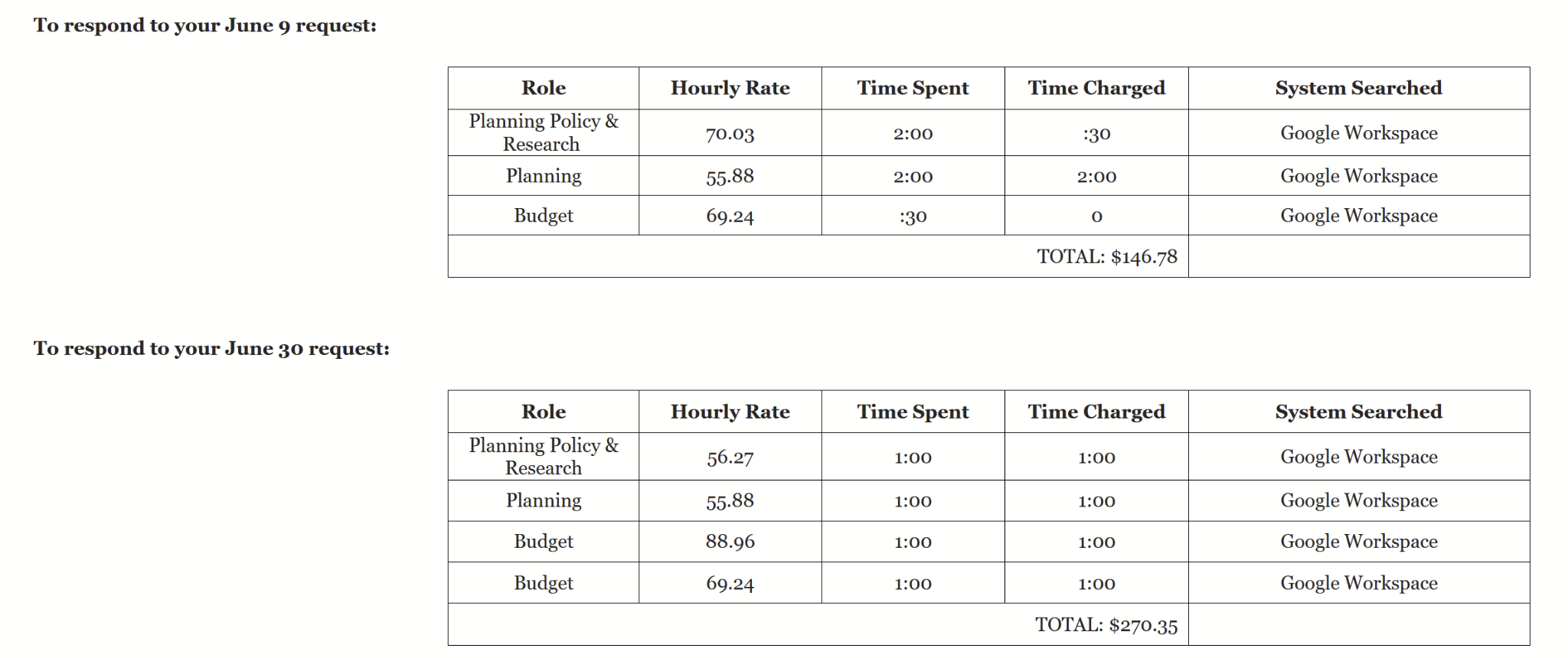
$417.13
$146.78 for the June 9 request and $270.35 for the June 30 request.
8.5 hours worked
CPS charged for 6.5 hours and absorbed 2 hours of reported staff time.
$55.88–$88.96
No clerk, records specialist, or general administrative rate appears in the breakdown.
Google Workspace only
Each of the seven labor entries identifies Google Workspace as the system searched.
FOIA is supposed to let citizens see how government decisions are made
Virginia FOIA allows a public body to recover reasonable actual costs, but it also requires the public body to make “all reasonable efforts to supply the requested records at the lowest possible cost.” In plain English: CPS should use the lowest-cost employee capable of performing the search. If a lower-cost records clerk, administrative employee, or ordinary custodian can locate the records, citizens should not be billed senior central-office rates. Read Va. Code § 2.2-3704(F).
What the staffing breakdown reveals
This is revealing. CPS did not list a clerk, records specialist, administrative assistant, school-based employee, or ordinary custodian. It listed Planning Policy & Research, Planning, and Budget, with rates from $55.88 to $88.96 per hour. Those are not rank-and-file search rates. Those are senior central-office rates.
The reasonable conclusion is that these searches were conducted by director-level, assistant-director-level, or similarly high-cost central-office employees. CPS can correct the record at any time by publishing the exact job titles, search terms, custodians searched, and why lower-cost employees could not perform the search.
The changing Planning, Policy & Research rates—$70.03 for the June 9 request and $56.27 for the June 30 request—and the two Budget rates—$88.96 and $69.24—also show that multiple central-office employees were involved. No lower-cost search role appears anywhere in the cost sheet.
The reasonable conclusion
CPS treated the Norfolk Highlands closure like a top-secret central-office project. The records were apparently so tightly held inside Planning, Planning Policy & Research, and Budget that high-cost leadership staff had to search for them personally. Rank-and-file CPS employees were not used for the search and do not appear to have been trusted with the underlying decision record.
That is the scope of the problem: CPS wants the public to accept the closure of a functioning neighborhood school, but the records are so centralized and so poorly disclosed that citizens have to pay senior-level rates just to be told the basic cost analysis does not exist.
If CPS says this inference is wrong, CPS should disprove it by releasing the job titles used, the custodians searched, the search terms used, and the actual cost model behind the proposal. Until then, this cost sheet is evidence that the NHP decision was handled inside a narrow senior-administration circle.
Itemized labor reported by CPS
| Request | Role / function | Hourly rate | Time spent | Time charged | System |
|---|---|---|---|---|---|
| June 9 | Planning Policy & Research | $70.03 | 2:00 | 0:30 | Google Workspace |
| June 9 | Planning | $55.88 | 2:00 | 2:00 | Google Workspace |
| June 9 | Budget | $69.24 | 0:30 | 0:00 | Google Workspace |
| June 9 total: $146.78 | |||||
| June 30 | Planning Policy & Research | $56.27 | 1:00 | 1:00 | Google Workspace |
| June 30 | Planning | $55.88 | 1:00 | 1:00 | Google Workspace |
| June 30 | Budget | $88.96 | 1:00 | 1:00 | Google Workspace |
| June 30 | Budget | $69.24 | 1:00 | 1:00 | Google Workspace |
| June 30 total: $270.35 | |||||
| Combined total: $417.13 | |||||
Timeline
- June 8, 2026CPS presented the Early Childhood Center plan involving Norfolk Highlands Primary.
- June 9, 2026Initial FOIA request submitted for source records behind the June 8 presentation.
- June 10, 2026CPS quoted $146.78 for part of the records response.
- June 16, 2026CPS provided the first FOIA response and source materials, but the core site-selection and alternatives analysis remained unresolved.
- June 30, 2026Follow-up FOIA requested records supporting the efficiency or cost rationale for the NHP proposal.
- July 9, 2026CPS responded that there were no responsive documents for the projected annual operating cost of keeping NHP open.
- July 9, 2026A follow-up email was sent to Superintendent Dr. Jared Cotton asking how the efficiency claim can be substantiated without the basic cost records.
- July 17, 2026CPS provided an itemized staff-rate and time breakdown showing $417.13 charged across the June 9 and June 30 requests, with every search line listing Google Workspace.
The June 30 FOIA request asked for these records
- The projected annual operating cost of keeping Norfolk Highlands Primary open in its current role.
- The projected net savings or net added cost to taxpayers from the proposed closure or repurposing.
- Any capital costs avoided or created by the proposed closure or repurposing.
- Any transportation cost changes caused by moving NHP students out and preschool students in.
- Any staffing/FTE changes used to support the efficiency claim.
- Any assumptions about enrollment loss, state/federal revenue loss, or local tax impact.
- Any alternative scenarios CPS evaluated, including keeping NHP open while expanding preschool seats elsewhere.
What CPS provided in response
| Request | CPS response | Why it matters |
|---|---|---|
| Projected annual operating cost of keeping NHP open | “There are no documents responsive to your request.” | This is the most basic number needed to support an efficiency claim. |
| Projected net savings or added taxpayer cost | Referred to the June 8 School Board meeting video. | A video is not a side-by-side cost model showing savings, added costs, assumptions, and tradeoffs. |
| Capital costs avoided or created | Referred to the June 8 School Board meeting video. | The public still lacks a written capital-cost comparison showing what is avoided, what is created, and what is merely deferred. |
| Transportation cost changes | Referred to the VPIv2 FOIA spreadsheet. | The public needs a direct transportation model for moving NHP students out and preschool students in. |
| Staffing/FTE changes used to support the efficiency claim | Referred to the VPIv2 FOIA spreadsheet. | The spreadsheet does not replace a public explanation of staffing impacts, shortages, and implementation risk. |
| Enrollment loss, state/federal revenue loss, or local tax impact | Referred to the VPIv2 FOIA spreadsheet; CPS stated local taxes are not impacted. | That still leaves unresolved whether revenue loss, transfer loss, and cost shifting were fully modeled. |
| Alternative scenarios, including keeping NHP open while expanding preschool elsewhere | Referred to the VPIv2 FOIA spreadsheet. | No formal side-by-side comparison has been produced showing why closing NHP is better than a distributed preschool model or K–5 expansion. |
The careful claim
Say this: CPS did not produce documents showing the projected annual operating cost of keeping NHP open, and it has not produced a true side-by-side cost comparison showing the net taxpayer impact of closing or repurposing NHP.
Do not overclaim: Do not say CPS admitted there are no utility bills, maintenance invoices, or school-level expenditure records. The FOIA asked for records supporting the projected operating cost and efficiency rationale. That is enough.
What is still missing
- NHP annual operating cost model
- Net savings or added taxpayer cost model
- Capital costs avoided or created
- Transportation cost impact
- Staffing/FTE impact model
- Distributed ECE comparison
- Single-hub ECE staffing risk analysis
- Receiving-school classroom capacity projections
- Portable-classroom cost and site assumptions
- K–5 conversion educational-benefit analysis
- Facility-prioritization explanation using updated conditions
Follow-up sent to Superintendent Dr. Jared Cotton
After CPS responded that there were no responsive documents for the projected annual operating cost of keeping NHP open, a follow-up email was sent to Dr. Cotton, with Fallon Graham and Tee Bunch-Boney copied.
The email asked Dr. Cotton to clarify why no responsive documents existed for the basic cost question and how CPS could continue to describe NHP as inefficient without producing records showing what NHP costs to operate, what taxpayers save by closing it, or what new costs are created by the proposal.
As of this update, no substantive answer has been received.
Why this matters
The public is being asked to accept a school closure based on efficiency. But the record produced so far does not show the basic math. Before the School Board moves forward, CPS should publish the cost comparison, alternatives analysis, transportation model, staffing assumptions, receiving-school capacity plan, portable-classroom plan, and facility-condition methodology.
Archive: June 9 FOIA request and June 10 cost quote
The original FOIA page has been preserved as foia-archive-june.html. It includes the June 9 request for the source records behind the June 8 Early Childhood Center presentation and the June 10 CPS cost quote of $146.78.